Eight Buck Converters, One Torture Bench: Which Marketplace Modules Actually Hit Their Amps
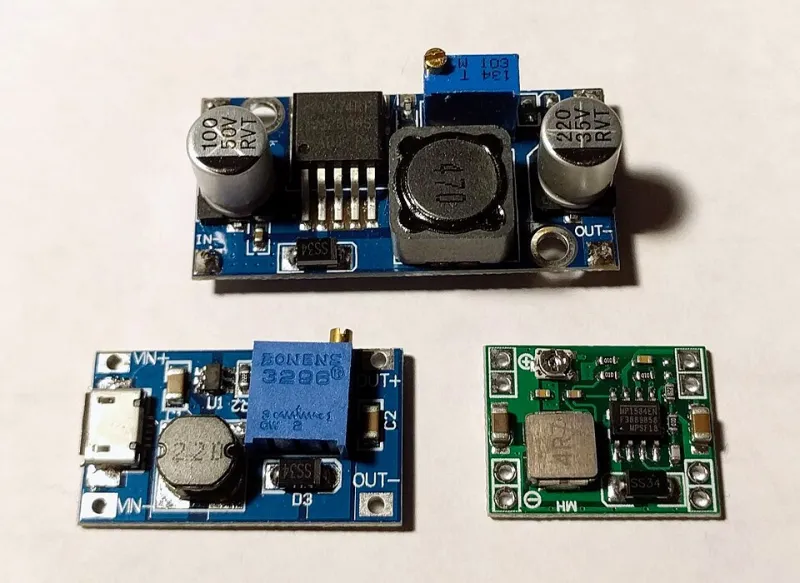
Photo: Matthew Berardi, CC BY-SA 4.0, via Wikimedia Commons
Search 'buck converter' on any US marketplace and you'll get thousands of listings, each with a wall of five-star reviews and a bold claim: 5A output, adjustable, pack of five. The review counts are real. The amps, it turns out, are negotiable.
We ordered eight different listings — XL4015 modules claiming 5A, LM2596 boards claiming 3A, and MP1584 minis claiming 3A — and strapped each one to a dummy load until something smoked, throttled, or died. Here's the scoreboard.
The Test Setup
Each module got the same treatment: input from a bench supply at a realistic 12V, output set to 5V, and a constant-current load stepped up in 0.5A increments until the module either hit its thermal limit or fell out of regulation. We logged temperatures with a thermocouple on the main chip and checked efficiency at each step. Then, the fun part — we desoldered the main IC on one sample per listing to see if the chip matched the silkscreen.
The Winners: Three Honest Workhorses
Listing A — XL4015 (5A claimed): Genuinely delivered 4.8A continuous before its thermal protection kicked in, and recovered cleanly. The desoldered chip was a real XL4015 with correct laser marking. This is the module you want for a solar charge controller or LED driver. It runs hot doing it — bolt on a heatsink — but it doesn't lie.
Listing D — LM2596 (3A claimed): The old reliable. Hit 2.9A sustained at 60% efficiency (the LM2596 is ancient and inefficient, but honest). Chip was genuine. At 3A it needed airflow, but it never dropped out of regulation.
Listing F — MP1584 (3A claimed): Here's the surprise. The listing claimed 3A, which is optimistic for this chip by any datasheet — but it managed a real 2.2A with a small heatsink before throttling. If the listing had said 2A, this would be a five-star product. Overstated, but not fraudulent.
The Losers: Five Listings That Overpromise
The other five fell into predictable failure patterns:
- Two XL4015 listings shut down at 2.1A and 2.6A respectively — less than half their rated output. Both had counterfeit or remarked chips under the hood; one had a completely different, cheaper controller that didn't match the silkscreen at all.
- Two LM2596 boards used fake or recycled ICs. One died permanently at 1.8A with a small firework on the inductor. Recycled chips pulled from e-waste are a documented problem, and our batch suggests it's widespread.
- One MP1584 mini couldn't hold 5V regulation past 1.4A, sagging to 4.6V — exactly the kind of 'works fine, then randomly reboots your ESP32' behavior that drives makers insane.
Why the Reviews Are Still Five Stars
Here's the thing: most buyers never pull more than an amp. They're stepping 12V down to 5V for a Raspberry Pi Zero or powering a sensor. At those currents, even the counterfeit modules work. The five-star reviews are genuine — they're just testing a fraction of the spec. The rating only collapses when you actually need the amps, say, driving a motor or a bank of LEDs. By then, you've left a review saying 'worked great' and moved on.
What to Buy Instead
Our take after the smoke cleared: buy the XL4015 from a listing that shows the actual chip clearly in photos and states realistic thermal behavior in the Q&A. Better yet, spend $2 more per module on a supply from a distributor like Digi-Key or Mouser, where the datasheet is a contract instead of a suggestion. Your project — and your LDO-fed microcontroller — will thank you.
Bottom line: of eight marketplace listings, three earned their stars. The other five earned a spot in the 'probably fine for 500mA' drawer.