Smoke, Sparks, and Surprises: How Cheap AC-DC Converter Modules Die Under Pressure
There's a certain kind of maker optimism that says, "It's rated for 2A, but I only need 1.8A, so I'm fine." We've all been there. The problem is that "rated for" on a $4 AC-DC converter module from an unfamiliar brand is doing a lot of heavy lifting — and it doesn't always mean what you think it means.
We decided to stop guessing and start breaking things. We picked up five budget AC-DC converter modules from different suppliers, all rated somewhere in the 5V/2A neighborhood, and we pushed them until they quit. Some quit quietly. Some quit dramatically. All of them taught us something useful.
The Lineup
We're not naming specific brands here because the supply chain for these things is a moving target — the module you buy today might have completely different internals than the one we tested. What matters more is the class of failure, not the logo on the board.
What we had: two flyback-based modules with encapsulated potting compound, one open-frame PCB design with visible components, and two compact "HLK-style" encapsulated bricks. Prices ranged from about $3.50 to $9 each. All were purchased through common US-accessible online marketplaces.
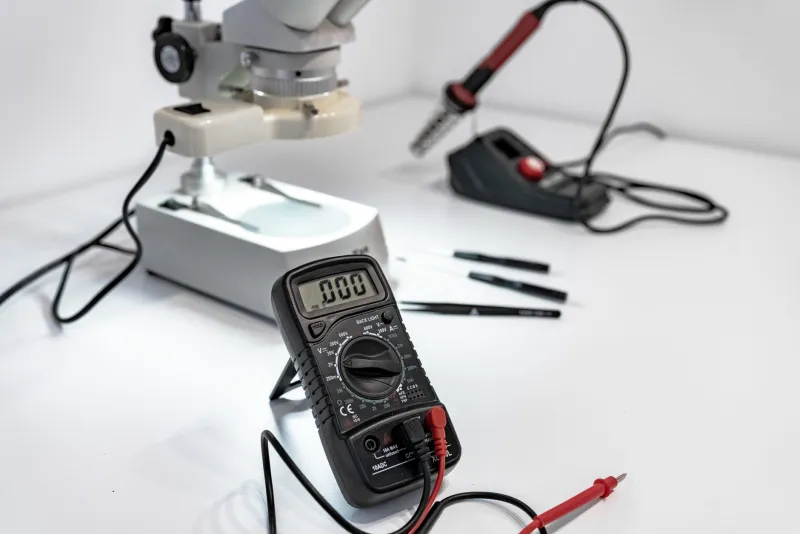
Our test rig was simple: a resistive load bank, a bench multimeter on the output, a clamp meter on the AC input, and a thermal camera watching the whole time. We also had a smoke detector, a fire extinguisher, and a healthy amount of respect for mains voltage.
What We Were Looking For
Before we started cooking these things, we defined what "failure" actually meant for our purposes. There are three categories:
Hard failure — the unit stops working entirely, either from a blown fuse, a fried component, or something more dramatic.
Soft failure — the output voltage drops significantly under load, but the unit technically keeps running. This is the sneaky one that kills your microcontroller project over time instead of all at once.
Thermal runaway — the unit keeps running, but gets so hot that it becomes a fire risk. This is the one that keeps us up at night.
The First Thing to Go: Output Capacitors
Across almost every unit we tested, the electrolytic output capacitors were the first components to show stress — and in three out of five cases, they were the first thing to actually fail.
Here's the corner that gets cut most often: cheap modules use capacitors rated for 85°C instead of 105°C. That 20-degree difference sounds minor until you realize that electrolytic caps lose roughly half their lifespan for every 10°C they run above their rating. Push one of these modules to 120% load on a warm day, and those caps are aging at something like four times their normal rate.
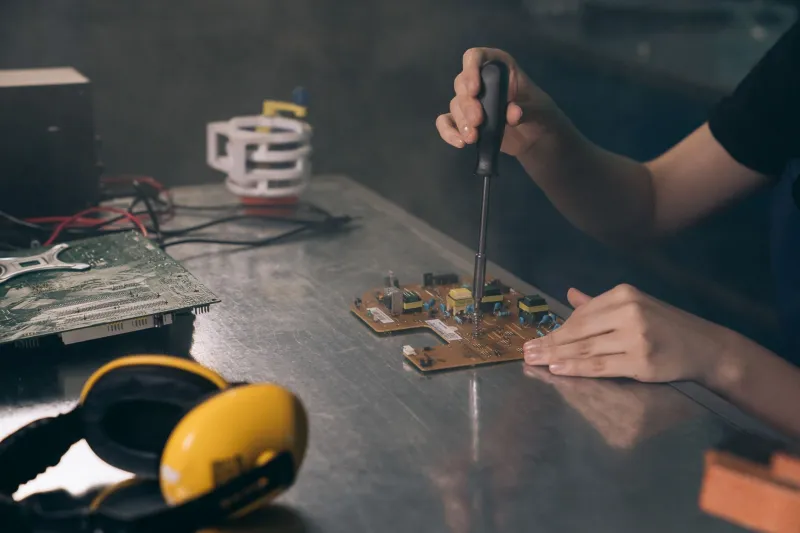
On our open-frame module, we could actually watch the output cap bulge slightly before voltage regulation started falling apart. That's your early warning sign — if you ever crack open a cheap converter and see a cap with a domed top, that module is already on borrowed time.
The Fuse Question
Two of our five modules had no input fuse at all. None. Just a direct connection from the mains input to the primary-side circuitry.
This is the difference between a component that fails safely and one that fails spectacularly. When one of the fusel-less modules hit a catastrophic overcurrent condition during our test, the primary-side MOSFET let go in a way that was... memorable. The encapsulated brick next to it, which did have an internal fuse, just went dark and stayed dark. One is a nuisance. The other is a potential hazard.
If you're buying AC-DC converters for anything other than a fully supervised bench setup, internal overcurrent protection isn't optional. It's the thing standing between your project and a bad day.
Thermal Performance: Where Cheap Design Shows Up
The thermal camera told the most interesting story. Our two HLK-style encapsulated bricks ran noticeably cooler at rated load than the open-frame design — probably because the potting compound acts as a heat spreader and the transformer is physically larger relative to the output power.
The open-frame module, on the other hand, had a tiny transformer crammed onto a small PCB with almost no airflow consideration. At 100% rated load, the transformer core was hitting 95°C on the surface. At 130% load, it climbed past 110°C before we pulled the plug. That's not a unit you want inside an enclosure without ventilation, and it's definitely not one you want to run continuously at anything close to its rated output.
The Gradual Degradation Problem
Here's the thing nobody talks about enough: most of these modules won't blow up on your workbench. They'll just slowly get worse.
We ran one module at 90% of rated load for eight hours straight, monitoring output voltage every 30 minutes. Over that period, output crept from 5.02V down to 4.87V. That's a 0.15V drop that happened gradually enough that you'd never notice it in day-to-day use — until your ESP32 starts throwing brownout resets and you spend a weekend chasing a software bug that was actually a hardware problem the whole time.
This is the failure mode that's hardest to catch and probably the most common. The unit "works," but it works worse and worse until something downstream misbehaves in a confusing way.
What Actually Survived
The two HLK-style bricks came out ahead on almost every metric. They ran cooler, maintained tighter voltage regulation under load, and when we finally pushed one past its limits, it shut down cleanly and came back online when we reduced the load. That's exactly the behavior you want.
They also cost more — about $7-9 versus $3-4 for the cheaper options. For a one-off project, that difference might not matter. For anything you're deploying long-term, leaving running unattended, or integrating into a product, it absolutely does.
Practical Takeaways for Makers
So what do you actually do with all this?
Derate aggressively. If a module is rated for 2A, plan to pull no more than 1.4A from it continuously. That headroom is what keeps the capacitors alive and the transformer cool.
Look for overcurrent protection. Before you buy, check the datasheet or product listing for mention of short-circuit protection or overcurrent shutdown. If it's not mentioned, assume it doesn't exist.
Check the capacitor spec. If you can see the output caps, look for a 105°C rating. 85°C caps in a converter that runs warm are a ticking clock.
Encapsulated doesn't automatically mean better, but it does usually mean the manufacturer was thinking about thermal management. It's a reasonable proxy for quality when you can't see the internals.
Give it airflow. Even a good module runs better with some air movement around it. Don't bury these things in sealed enclosures and expect them to hit their rated specs indefinitely.
The honest truth is that most budget AC-DC converters will work fine under most conditions — right up until they don't. Knowing how they fail makes it a lot easier to design around the failure modes that matter most for your specific project. And if you're ever unsure, spending an extra four bucks on a better module is almost always the right call.