We Wired Up a Whole Maker Workshop and Measured Everything — The Power Bill Was Embarrassing
Most makers are pretty good at optimizing the stuff they're actively building. You'll spend an hour shaving milliamps off a battery-powered sensor project, but then leave your soldering station in standby mode for six hours while you're binge-watching YouTube on the couch. That's the contradiction we wanted to dig into.
So we did something a little obsessive: we grabbed a Kill-A-Watt meter, a clamp meter, and a USB power analyzer, and we went around a real working maker's bench — the kind with years of accumulated gear — and measured everything. Not just the obvious stuff. Everything.
Here's what we found.
The Setup We Were Working With
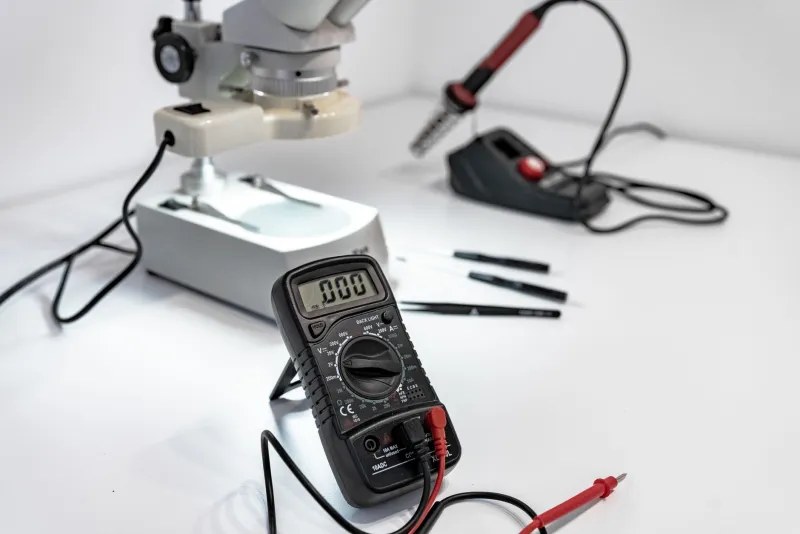
This wasn't a staged photo-shoot bench. It was a lived-in workspace with a mid-range temperature-controlled soldering station, two digital multimeters (one name brand, one no-name clone), a benchtop DC power supply, a cheap oscilloscope, a laptop perpetually plugged in, a USB hub, a label maker, and a small LED desk lamp. Pretty standard kit for anyone who's been doing this a while.
Total outlets in use: 11. Total devices: 14 (counting things daisy-chained through the hub).
We measured idle draw — meaning everything was powered on but nothing was actively being used — for a 24-hour simulated period, then extrapolated to monthly and annual costs using the current US average residential electricity rate of about $0.16 per kWh.
The Soldering Station: Sneakier Than You Think
This one surprised us the most. A popular mid-range temperature-controlled iron — the kind with a digital display and a ceramic heating element — pulled around 8 watts continuously when sitting in the holder at idle. Not off. Not in a true sleep mode. Just sitting there, maintaining tip temperature because the user never actually switched it off between sessions.
Over a month of typical workshop use (let's say 6 idle hours a day), that's roughly 1.44 kWh per month, or about $0.23. Doesn't sound bad until you remember it's doing absolutely nothing useful during that time. Over a year, you're looking at nearly $2.75 just from a soldering iron that's "resting."
The fix is annoyingly simple: get a station with an auto-sleep function, or — radical idea — turn it off when you walk away.
Multimeters: The Ones You Forgot Were On
Here's a category almost nobody thinks about. Digital multimeters left in voltage or continuity mode, sitting on the bench with the probes dangling, still draw power. The name-brand meter we tested pulled about 1.2 mW — basically nothing. But the cheap clone? 4.8 mW continuously, and it had no auto-shutoff.
That's not a budget-breaker by itself. But multiply it by three or four meters on a bench (we've all got spares), running all day, and you're adding a few cents a month per meter. The real issue is battery drain — those cheap meters will eat through a 9V battery in a few months of always-on use, and suddenly your "cheap" meter is costing you $5 a year just in batteries.
The DC Bench Supply: A Bigger Leak Than Expected
This one genuinely caught us off guard. A budget 30V/5A bench supply — the kind you'll find for $50-70 on Amazon — pulled 6.1 watts at idle with no load connected. Just on, display lit, output enabled but nothing attached.
That's 4.4 kWh per month if you leave it on 24/7, which some people do because it's inconvenient to recalibrate voltage and current limits every session. At $0.16/kWh, you're spending about $0.70 a month, or $8.44 a year, on a power supply that isn't supplying power to anything.
Better units have standby modes or fan-speed-controlled operation that drops idle draw significantly. If you're shopping for a bench supply, idle consumption is worth checking in the specs — or at least in the reviews.
The USB Hub: An Oldie but a Baddie
We've covered USB hubs before, but the number keeps being gross. A 7-port passive hub with nothing plugged into it pulled 1.8 watts. With devices attached but idle, it climbed to 3.4 watts. That's the hub itself doing nothing productive while things like a USB UART adapter and a Raspberry Pi zero sat dormant.
Annualized at typical usage: roughly $3-4 a year just from the hub overhead. Not catastrophic, but it's also not zero.
The Laptop Charger: Always the Usual Suspect
A 65W USB-C laptop charger left plugged in with the laptop at 100% battery pulled 4.3 watts. This is well-documented territory at this point, but it keeps showing up in every audit because people keep doing it. Unplug the charger when the laptop is full. That's it. That's the advice. It saves you about $4-5 a year and reduces heat stress on the adapter.
The Oscilloscope: Actually Not That Bad
Credit where it's due — the budget DSO we tested (a common 50MHz entry-level unit) pulled only 9 watts active and dropped to 6.8 watts when the screen dimmed after the auto-sleep timeout. That's reasonable for what it is. No complaints here.
The Total Tally
Adding it all up across all 14 devices in idle/standby states:
| Device | Idle Draw | Monthly Cost (est.) |
|---|---|---|
| Soldering station (idle) | 8.0 W | $0.92 |
| Bench DC supply (on, no load) | 6.1 W | $0.70 |
| Laptop charger (plugged in, full) | 4.3 W | $0.49 |
| USB hub (devices attached, idle) | 3.4 W | $0.39 |
| Oscilloscope (sleep mode) | 6.8 W | $0.78 |
| LED lamp (on, no task) | 4.5 W | $0.52 |
| Misc small adapters & meters | ~3.0 W | $0.34 |
| Total | ~36 W | ~$4.14/mo |
Annualized: roughly $49 a year from a workshop that's not actively doing anything.
What You Can Actually Do About It
The good news is that most of this is fixable without spending much money. A couple of smart plugs with scheduling — you can grab decent ones for under $10 each — let you cut power to the whole bench when you're not using it. A single switched power strip works just as well if you're disciplined about flipping it.
For the soldering station, look for models that advertise auto-sleep or "hibernation" modes. They're not much more expensive than dumb stations, and they'll pay for the difference in electricity savings within a year or two.
For the bench supply, just get in the habit of switching it off at the unit when you're done. Set the voltage before you turn it on — it takes ten seconds.
None of this is revolutionary. But $49 a year is almost enough to buy a decent new component kit or a replacement tip set. That's real money for a hobby that already asks a lot of your wallet.
Measure your own bench. You might be surprised what you find.